Dad rings me up and says, “Marcin, how about putting that spaghetti recipe on your website, the one you made at ours the other day? I could impress your mum.” Dad, I love you. And of course, here’s your recipe.
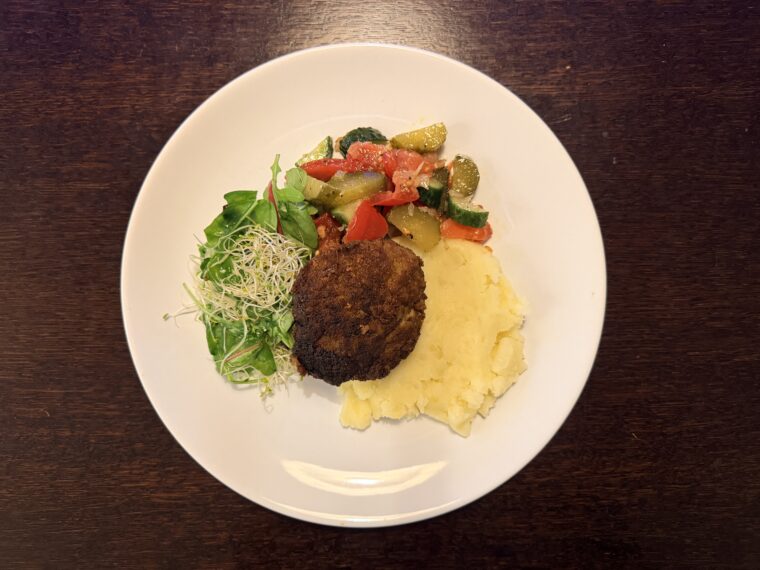
Unfortunately I haven’t taken a picture lately of my take on classic bolognese (more simplified than complicated, naturally), so the photo above the post shows the version with added courgette. That means it’s in the recipe too, but Dad, remember: if you want it the way it was when I visited, leave the courgette out.
A few more words about the recipe. It’s supposedly about the sauce, but really it’s for the whole dish we call spaghetti bolognese, pasta Bolognese-style and so on here in Poland. Personally I like bolognese best with tagliatelle. I very rarely make it with spaghetti. At my parents’ place, though, I fancied long strands of thick pasta, so that’s what I made. Just remember, whatever pasta you choose, and you’ve pretty much got free rein here, bolognese sauce is an absolute classic.
A primitive dish that’s incredibly easy to make, even though I think it tastes best after a long simmer. As I keep saying, the most important thing in my kitchen is remembering there’s a pot on the stove (several pots if you’re playing on hard mode). Check the food every 5 to 10 minutes and give it a stir, even if you’re simmering or frying it for ages over a low “flame” (find me a word for that ;).
I also use this recipe as one of the components of a classic meat lasagne.
At a glance:
Prep time: 20 minutes
Frying/cooking time: 2 hours (if you want it really good)
Serves: up to 4
How many calories: Italian men are handsome, so they probably have a good metabolism. A lot…
Ingredients for my bolognese sauce:
- 80 dag minced beef (if you prefer, buy pork that isn’t too lean. Minced turkey thighs work very well too, as they aren’t as dry as turkey meat tends to be)
- 4 cloves of garlic
- one chilli (as you already know, I like it hot. You don’t have to. Feel free to leave it out)
- coarsely ground black pepper
- 500 grams of tomato passata
- 2 large tomatoes (peeled)
- 2 large carrots
- 1 large courgette (DAD, leave this one out)
- 2 medium onions
- half a packet of dried herbes de Provence
- a teaspoon of salt
- a teaspoon of sugar
- two tablespoons of concentrated tomato purée
- 10 dag Parmesan
- olive oil
Method (let’s make pasta sauce, Bolognese-style):
Right, got to start somewhere. For a primitive kitchen there are quite a few ingredients here, so I’ll have to concentrate. I crush the garlic with my fist and chop it into little bits. I heat olive oil in a medium-sized pot (not too much, otherwise you get sauce and slicks of grease on your plate, which isn’t great) and throw in the garlic, then the finely chopped chilli (another thing you can leave out if you don’t like too much heat). After about a minute I add the meat. In go the salt and half the herbes de Provence, and for the next 7 minutes I stir vigorously and break the meat up. The idea is to stop it burning and to get it as fine as possible.
Once the meat has fried with the seasonings, I add the finely chopped onions. I stir vigorously again for about 3 to 4 minutes. I add the carrots (finely chopped too) and the courgette. I keep stirring and frying over medium “heat”. In go the peeled tomatoes, cut into quarters (tinned will do, though I prefer fresh). Now for the monotonous bit. More stirring. Up to 5 minutes or so.
When all the water from the veg has evaporated and the meat and everything else starts frying again, I add the passata. That should cool things down for a moment. I also turn down the “heat”. If it loses water too quickly and starts bubbling and spattering red spots all over the kitchen, I add half a glass of water. Then I add 2 tablespoons of concentrated tomato purée, along with the remaining herbes de Provence. And I let it cook. Leave the lid off, whatever you do. I don’t want to suffocate my Bolognese, I want it to reduce.
And so it goes for the next two hours. If the sauce starts drying out, I add half a glass of water and check it every 5 to 10 minutes. And stir. And stir. And stir. An hour into the game, I start tasting to see if the seasoning is right. If it needs salt, I add salt. If it’s too sour, a little sugar. If it’s not herby enough, more herbes de Provence. After two hours the sauce should be thick enough that you don’t end up with soup on the plate. I take it off the heat.
I usually serve it over tagliatelle and sprinkle it generously with grated Parmesan. Just make sure the pasta’s cooked al dente (in other words, not too soft). Enjoy!


STRAIGHT TO YOUR INBOX
New recipe? I’ll let you know.
Sign up to get the next recipe in your inbox.